
How does width tolerance after coil slitting affect bending and stamping and construction project assembly?
In the steel sheet industry, when talking about material quality, many people often immediately think of thickness, coating thickness, surface or blank origin. However, from a practical construction and fabrication perspective, there is a very important parameter that is often overlooked: actual width of the sheet after uncoiling. This factor directly affects the accuracy of subsequent stages such as bending, forming, roll forming, seaming, screwing, installing trims, installing gutters, making doors, making panels, cladding walls, or sheet metal mechanical parts.
If the width of the sheet after uncoiling deviates from the required dimension, that error does not stop at a single sheet. It will propagate into a chain error throughout the entire production and erection process. A detail off by a few millimeters can cause uneven bent edges, misaligned punched holes, open seams, aesthetically unpleasing assembled structures, increased material waste, and higher rectification costs at the construction project.
For construction projects requiring fast progress, high repeatability, and consistency between details, controlling the width error after uncoiling is no longer a “minor” issue. It is a critical link determining precise fabrication capability and smooth acceptance.
1. What is width error after uncoiling?
Width error after uncoiling is the difference between required width dimension and actual dimension of the sheet after being uncoiled from a steel sheet coil or steel coil. For example, if a customer requests a cut width of 500mm, the actual finished product might be 498mm, 499mm, 501mm, or 503mm, depending on the accuracy of the machine system and operating procedures.
Visually, a difference of a few millimeters may seem small. But in mass production or in structures requiring continuous assembly, this level of error can become a very significant problem. A roof, wall, trim, or accessory detail that is off-width will lead to:
- Loss of positional accuracy during bending and stamping.
- Does not match previously fabricated details.
- Requires manual cutting and adjustment at the construction project.
- Generates scrap or requires redoing the entire batch.
- Affects surface aesthetics upon final installation.
In practice, professional contractors and fabrication workshops often do not just look at the “nominal cut width”. They are concerned with actual cut width, consistency between sheets and dimensional repeatability across the entire batch. Because one correctly sized sheet is not enough; it is important that the entire batch is uniform for quick bending, punching, assembly, and installation.
2. Why is width error after uncoiling prone to occur?
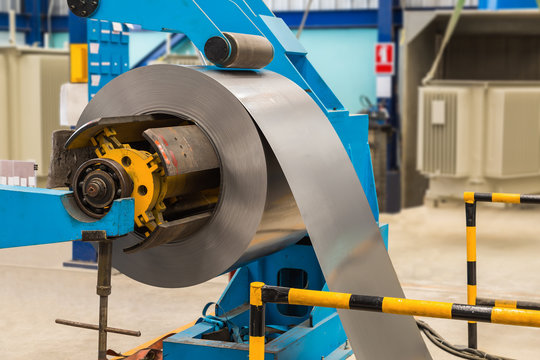
To understand why this stage is important, one needs to look at the true nature of the uncoiling process. The input material is a metal coil with residual stress, which may have slight curvature, coil set, edge stretch, and in some cases, minor fluctuations in usable width. When passing through the uncoiling, leveling, and cutting system, if the machinery or operation is not precise, errors will appear.
Common causes include:
2.1. Improper cutting blades and edge guiding system
If cutting blades are worn, misaligned, blade clearance is not optimal, or the edge guiding system is unstable, the cut edge may deviate in dimension. When cutting large quantities, the deviation becomes more apparent.
2.2. Uneven input coil
Some material coils have varying tightness between wraps, unstable coil edges, or slight edge drift. When fed into the machine, if the material does not run perfectly straight, the actual width after uncoiling will fluctuate.
2.3. Inadequate leveling
If the steel sheet still has curvature, warping, or if stresses have not been properly relieved before cutting, the sheet after leaving the machine may experience slight “dimensional bounce” due to material springback. This is particularly common with thin, wide, or high-strength materials.
2.4. Excessive uncoiling speed
Many units prioritize speed for quick output, but if running too fast without proper control, the material may deviate from the path, causing repeatable errors between sheets.
2.5. Lack of in-process batch inspection
A very common mistake is to only measure the first sheet and then proceed with mass production. Meanwhile, errors can appear in the middle or end of the batch due to blade heating, changes in coil tension, or slight machine vibration over operating time.
3. How does width error affect the bending and stamping stage?
This is the most important part. In bending and stamping, especially for edge folding, box bending, U-bending, V-bending, trim bending, gutter bending, or forming cladding accessories, the input blank width directly determines the final geometry. When the blank width is incorrect, the finished product will almost certainly be incorrect as well.
3.1. Incorrect flange dimensions
For example, a detail needs to be bent into a U-shape with two equal flanges. If the blank width is smaller than required, after subtracting the bending radius and the bent edges, the finished flange will be undersized. If the blank is oversized, the flange will be larger than the drawing. This error prevents the detail from fitting into the frame system or matching the corresponding part.
3.2. Off-center bend line
Many details are aligned from the sheet edge. When the edge width is incorrect, the entire bend line position shifts accordingly. The result is that the detail still “looks right”, but in actual assembly, it does not match holes, rails, or trims.
3.3. Increased risk of distortion and part twisting
When the width is inconsistent between blanks, the bending force applied to each sheet is no longer uniform. This easily leads to parts being angled, slightly twisted, or locally distorted, especially with long, thin, or wide sheets.
3.4. Loss of repeatability in mass production
In industrial production, it is important not only to make one correct part but to make 100 identical parts. If the input width fluctuates, operators must constantly adjust the machine, increasing setup time, reducing productivity, and increasing the risk of errors.
3.5. Causes difficulties for punching, rib forming, and shape forming stages
If a detail needs to be bent and punched according to standard positions, the width error will shift the entire fabrication coordinate system. At this point, even if the punching machine is very accurate, the final product will still be incorrect because the initial reference was wrong.
4. Impact of width error on assembly at the construction project
At the construction project, the impact of errors is often much more apparent than in the workshop. A sheet or a detail with an incorrect width may not be immediately detected on the fabrication table. But when brought to the site and installed into the frame system, all errors will become apparent simultaneously.
4.1. Open seams, misaligned seams, insufficient overlap
For roof, wall, trim, or gutter systems, incorrect width causes the overlapping section to no longer match the design. The result is that the joint edge may be open, lack coverage, or deviate from a straight line, which is both unsightly and increases the risk of water leakage.
4.2. Does not match the frame system or accessories
Many steel sheet details are designed to be installed with purlins, support bars, door frames, rails, or panels. When the actual width deviates, workers are forced to grind, trim, shim, or screw off-center. This is a workaround, not an optimal technical solution.
4.3. Increased construction time and labor costs
When goods arrive at the construction project and require manual adjustments, progress is immediately delayed. Laborers must re-measure, re-cut, re-bend, or replace. If the number of errors is high, rectification costs can far exceed the cost difference between a precise fabrication unit and one lacking control.
4.4. Affects overall aesthetics
In construction projects with high surface requirements such as showrooms, prefabricated office buildings, commercial areas, modern workshops, wall cladding and covering details need to be straight, uniform, and sharp. Small but continuously repeated errors will create the impression that the construction project is misaligned and lacks meticulousness.
4.5. Causes cascading material waste
An incorrectly sized part does not just damage itself. It can damage the entire accompanying assembly chain, requiring additional replacement of trims, screws, gaskets, adhesives, or even the entire related assembly.
5. Which cases are particularly sensitive to width error?
Not all applications are equally sensitive. Width error is particularly noteworthy in the following cases:
- Fabrication of trims, ridge caps, gutters, eaves: because the geometry is highly dependent on the blank width.
- Details of box bending, U-bending, V-bending: even a slight deviation immediately results in incorrect finished product dimensions.
- Panels, cladding panels, steel doors, electrical cabinets, metal furniture: require high fit accuracy between multiple components.
- Wide sheets or long lengths: small input errors can easily be amplified during assembly.
- Mass production: errors are no longer isolated errors but become systemic errors.
6. How to control width deviation from the outset
To effectively control bending and stamping and assembly, it cannot only be checked at the final stage. It needs to be checked right from the input and at the slitting stage.
6.1. Choose the right material and supplier
Input material is a fundamental factor determining the stability of dimensions after slitting. A steel sheet coil with uneven width, flared coil edge, or an unstable coating layer will make the cutting process difficult to achieve high accuracy, no matter how good the machinery is.
Therefore, the choice of supplier should not be based solely on price. For technical orders, especially for bending and stamping and assembly, it is necessary to prioritize suppliers with integrated control from raw material source → slitting → fabrication.
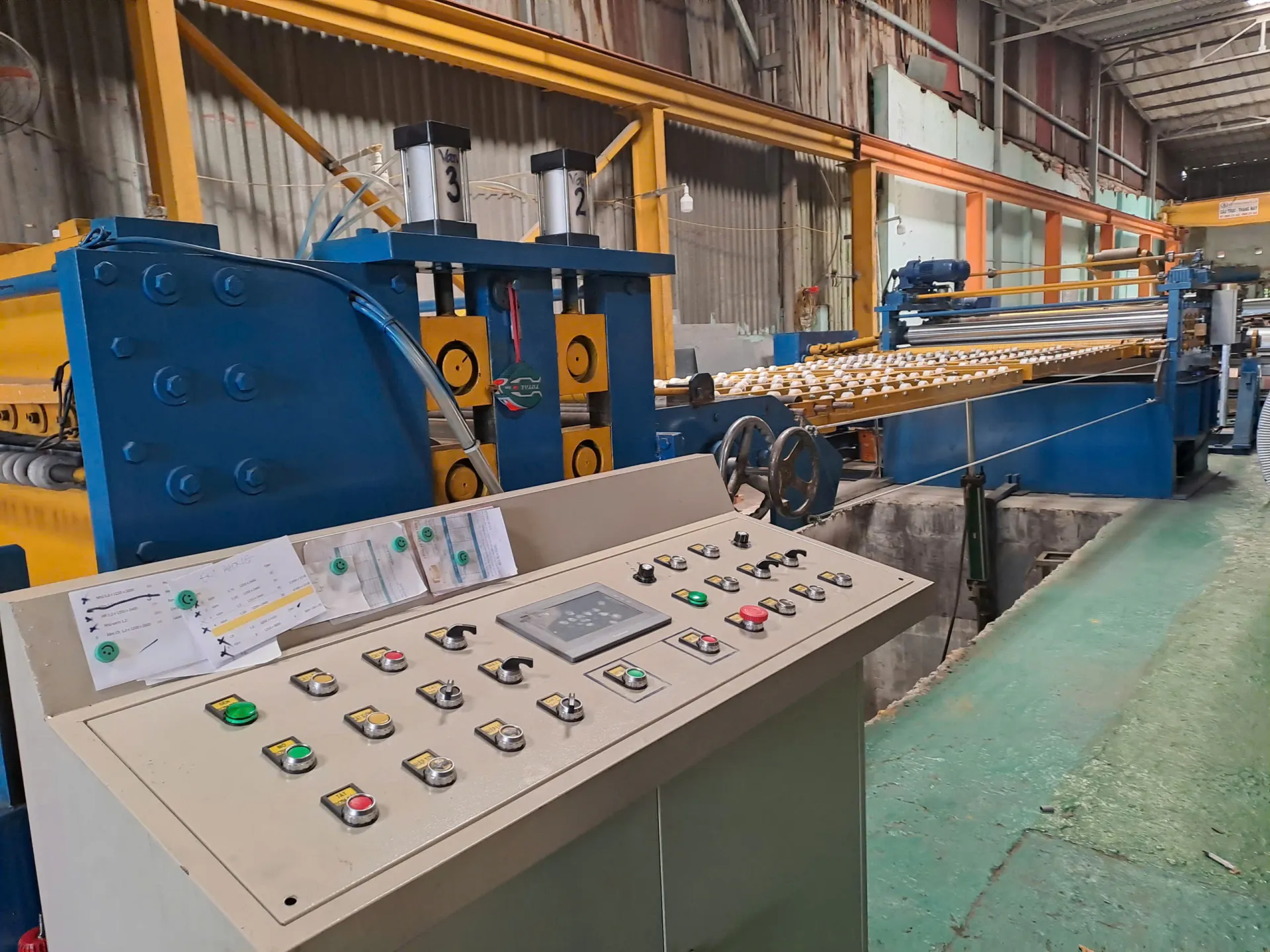
In practice, units with a system of integrated slitting and bending and stamping machines, a technical team that understands drawings and a batch-based dimension inspection process will significantly reduce width deviation from the outset. This is particularly important for applications requiring high repeatability such as mass production, sheet metal fabrication, or workshop structures.
Phu Cuong Steel Sheet and Steel – Accompanying Every Construction Project is one of the units that well meets this requirement by providing both materials and fabrication services. With the advantage of genuine raw material sources, a system of new technology slitting – cut-to-size – bending and stamping machines, along with a technical team knowledgeable in drawings, the products after fabrication achieve high uniformity, limiting deviation between sheets.

Additionally, on-site fabrication at the warehouse helps control dimensions directly during the production process, instead of relying on multiple intermediaries. Combined with a system of dedicated delivery trucks, the unit can optimize logistics costs and ensure progress for orders requiring quick deployment.
For construction projects with high technical requirements, choosing the right supplier from the outset not only helps ensure quality but also significantly reduces rework costs and risks arising during construction.
6.2. Use a system of stable slitting machines with precise edge guiding
Good machinery not only helps cut quickly but also helps maintain high repeatability between sheets. For technical orders, machine stability is as important as the material itself.
6.3. Batch-based dimension inspection, not just checking the first sheet
Regular checks should be performed throughout the fabrication process: at the beginning, middle, and end of the batch. This method helps detect dimension deviation early before errors spread throughout the entire batch.
6.4. Coordinate bending drawings with actual slit width
Many errors arise due to bending workshops and slitting workshops working disjointedly. There must be consistency between blank width, bending radius, flanging sequence, and target finished product dimensions.
6.5. Consider tolerance for specific applications
Not all components use the same tolerance level. Decorative components, water-tight joint components, rail mounting components, technical box components… each type has different requirements. Tolerance needs to be determined according to the specific purpose of use, instead of applying a general level for all.
7. Optimize from the perspective of contractors and mechanical workshops
For contractors, the concern is not just how much cheaper the slitting price is per kilogram, but rather total cost of ownership of the order. A low-priced batch with high deviation will increase hidden costs: rework, delayed progress, material loss, additional labor, material replacement, reduced reputation with the investor.
For mechanical workshops, controlling standard width from the outset significantly reduces machine bending adjustment time, reduces scrap, increases on-time delivery capability, and builds trust with B2B customers. From an operational perspective, this is a direct factor affecting productivity and profit margins.
In other words, accurate slitting is not a minor matter. It is the foundational step for the entire subsequent fabrication system to run smoothly, from bending and stamping to on-site assembly.
8. Conclusion
Width deviation after slitting is one of the silent but very common causes of errors in the bending and stamping and assembly stages. This deviation can cause incorrect bending wing dimensions, incorrect hole punching positions, open seams, misaligned accessories, increased material loss, and delayed construction progress. In technical orders, especially industrial B2B orders, the accuracy of the cut width does not only affect one component but affects the entire production chain.
Therefore, when ordering fabricated steel sheet and steel, businesses should prioritize units with stable material sources, integrated slitting and bending and stamping machinery, strict dimension control and a clear understanding of the technical requirements for each application. This is the real way to reduce errors, instead of dealing with consequences once goods have reached the construction project.
Phu Cuong Steel Sheet and Steel – Leading Reputable Wide Steel Sheet Distributor
If you are looking for a steel sheet and steel supplier with the capability to slit, cut-to-size, bend and stamp, and perform on-site fabrication with high accuracy, Phu Cuong Steel Sheet and Steel – Accompanying Every Construction Project is a suitable choice for various needs from workshops, mechanical engineering, metal structures to industrial cladding items. Our motto is Quality builds reputation, therefore, each order does not just stop at material delivery but also aims for technical suitability and practical usage efficiency.
Phu Cuong currently supplies key product lines such as EG steel sheet, GA steel sheet, galvanised steel sheet, along with many common specifications and wide widths such as 1000mm, 1250mm, 1500mm. This is an important advantage for units requiring wide steel sheets to reduce joints, reduce material loss, and optimize finished product design. In addition, we have a system of slitting – cut-to-size – bending and stamping – on-site warehouse fabrication machines, supporting fast, uniform order processing and limiting deviation during production.
Beyond material supply, Phu Cuong also supports fabrication services such as slitting, custom cutting, bending and stamping, on-site steel sheet fabrication to help customers reduce points of contact and save implementation time. Owning our own delivery trucks also helps optimize logistics costs, manage progress proactively, and support more flexible delivery for customers in Ho Chi Minh City and surrounding areas.
Contact information:
Address: 2177C–2177D QL1A, P. Đông Hưng Thuận, Q.12, TP.HCM
Phone: 0933 919 899
Email: tonthepphucuong@gmail.com
Website: tonthepphucuong.com
See more related articles:
- Where to Buy EG Steel Sheet Reputably in Ho Chi Minh City? Quotation & Experience in Choosing the Right Standard
- How Does the Lifespan of Galvanised Steel Sheet Depend on the Z120 – Z180 – Z275 Coating Layer?
- What Is Electro-galvanised Steel? Why Is It Widely Used in the Door, Electrostatic Painting, and Metal Furniture Industries?
- What Is Springback When Bending Steel Sheet? Why Is the Finished Product Still Incorrect Even When Bent at the Correct Angle on the Machine?