Mistake when only measuring steel sheet with calipers: Why do many contractors incorrectly assess material quality?
1. Why does the caliper become the “standard” for checking steel sheet at the construction project?
In reality, when receiving steel sheet and steel, the most used tool is almost by default caliper. The reason is very simple: calipers are cheap, easy to buy, easy to use, and provide an immediate number.
Many contractors and construction teams have a habit:
- Hold a caliper and measure one edge of the steel sheet
- Compare the displayed number with the thickness stated on the quotation
- Quickly conclude: “sufficient thickness” or “insufficient thickness”
The problem lies in the fact that: the caliper is not wrong, but the way it is used and the way the results are interpreted are often wrong.
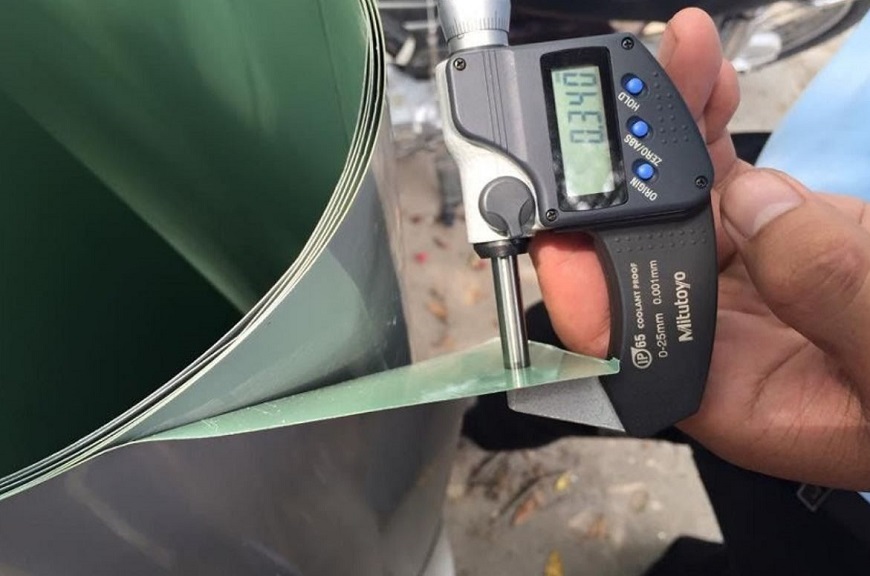
2. What can a caliper measure and what can it not measure?
Essentially, a caliper can only measure thickness at a very small point on the steel sheet, at the time of measurement.
Caliper can measure:
- Instantaneous thickness at the point of contact
- Small deviation between measurement points
But a caliper cannot measure:
- Average thickness of the entire steel sheet
- Degree of compliance with technical tolerance
- Uniformity over the entire length of the coil
- Actual weight of the material
Therefore, relying solely on a single caliper measurement to conclude material quality is lacking technical basis.
3. Common mistake number 1: measuring one point and then concluding for the entire batch
This is the most common mistake. A measurement at one edge of the steel sheet or any corner does not represent the entire coil or batch of steel sheet.
In steel sheet and steel production:
- Thickness may vary slightly across the width
- Different areas may fall within different tolerances
Measuring a thinner point and concluding “steel sheet with insufficient thickness” is a subjective assessment that does not reflect reality.
4. Common mistake number 2: not calibrating or using an inaccurate caliper
Many calipers used at the construction project:
- Have been impacted, bent or warped
- Are not regularly calibrated
- Accuracy is no longer guaranteed
In some cases, the caliper may even display an error of a few hundredths of a millimeter, enough to mislead the contractor into believing the material has “insufficient thickness”.
If the measuring tool is unreliable, the measurement results are also unreliable.
5. Common mistake number 3: not distinguishing between base steel thickness and post-coating thickness
A very often overlooked point is: steel sheet thickness includes the base steel and the coating layer.
When measuring with a caliper:
- May measure at a location with a thin coating layer
- May measure at a location where the surface is not perfectly flat
If the material composition is not clearly understood, the measurement results can lead to misunderstandings about quality.
6. Common mistake number 4: ignoring technical tolerance
As analyzed in previous articles, thickness tolerance is a mandatory factor in industrial production.
However, many contractors when measuring with a caliper:
- Compare directly with the nominal value
- Do not compare with the permissible tolerance
As a result, steel sheet that meets standards is still deemed “not meeting standards”, causing unnecessary disputes.
7. Common mistake number 5: not cross-referencing with CQ and technical standards
A caliper is only a supporting tool. CQ and technical standards are the official basis for material evaluation.
In many cases:
- Steel sheet meets all standards according to CQ
- But is still suspected due to a single measurement
This is an approach contrary to professional material evaluation procedures.
8. Practical consequences of incorrect evaluation using a caliper
Incorrectly evaluating steel sheet quality using a caliper can lead to several consequences:
- Heated disputes with suppliers
- Construction delays due to material suspicion
- Impact on long-term cooperative relationships
- Overlooking other more important actual risks
More seriously, contractors might overlook truly under-gauge steel sheet if they only look at the measured number without an overall assessment.
9. How to check steel sheet thickness more accurately than a single caliper
To scientifically check steel sheet thickness, a combination of the following should be used:
- Measure multiple points on the same steel sheet
- Measure on several different sheets in the batch
- Cross-reference with CQ and applicable standards
- Check the actual weight of the steel sheet coil
This is the method often applied by supervision consultants and major contractors.
10. When is a caliper still useful?
A caliper is still very useful when:
- Quickly detecting unusual deviations
- Relative comparison between shipments
- Supporting initial inspection at the construction project
The important thing is not to use a caliper as the sole tool to conclude on quality.
11. The supplier's role in supporting thickness inspection
Many disputes can be avoided if the supplier proactively explains clearly how to inspect materials.
Phu Cuong Steel Sheet & Steel – Accompanying Every Construction Project. Phu Cuong not only supplies galvanised steel sheet, electro-galvanised steel sheet EG – GA but also guides customers on how to technically inspect thickness, cross-reference CQ and standards, helping contractors avoid incorrect material assessment at the construction project.
12. Conclusion
A caliper is a useful tool but not the “final judge” in assessing steel sheet and steel quality. Measuring only with a caliper and drawing hasty conclusions can lead to many misunderstandings and risks. Correctly understanding the role of a caliper, combined with technical documentation and overall inspection, is the right and professional approach.
CONTACT FOR THE FASTEST QUOTATION
PHU CUONG STEEL SHEET & STEEL CO., LTD
Hotline/Zalo: 0933.91.98.99 (Ms. Ánh)
Hotline/Zalo: 0933.91.98.98 (Mr. Mạnh)
Website: tonthepphucuong.com
Commitment: Best price – On-time delivery – Standard quality products.
See related articles:
- What is grey electro-galvanised steel sheet? Structure, SECC – GA standards and industrial applications
- What is Cold-Rolled Steel? What is CR Oil Steel Sheet? Differentiating Hot-Rolled Steel and Cold-Rolled in Steel Sheet and Steel Fabrication
- Why is actual steel sheet often thinner than the declared figure? Technical facts and what contractors need to understand