SECC vs SGCC: Compare steel door materials & 5 risks of choosing incorrectly (what workshops need to know)
Many steel door workshops choose materials based on price, overlooking technical factors. The result after fabrication: doors warp, paint defects, assembly misalignment – and the defective product rate increases by 5–15% without clear cause.
In most cases, the problem lies not with machinery but with material selection between SECC and SGCC. This article analyzes in detail the differences and practical risks of incorrect selection.
In-depth comparison of SECC and SGCC (from material structure to fabrication performance)
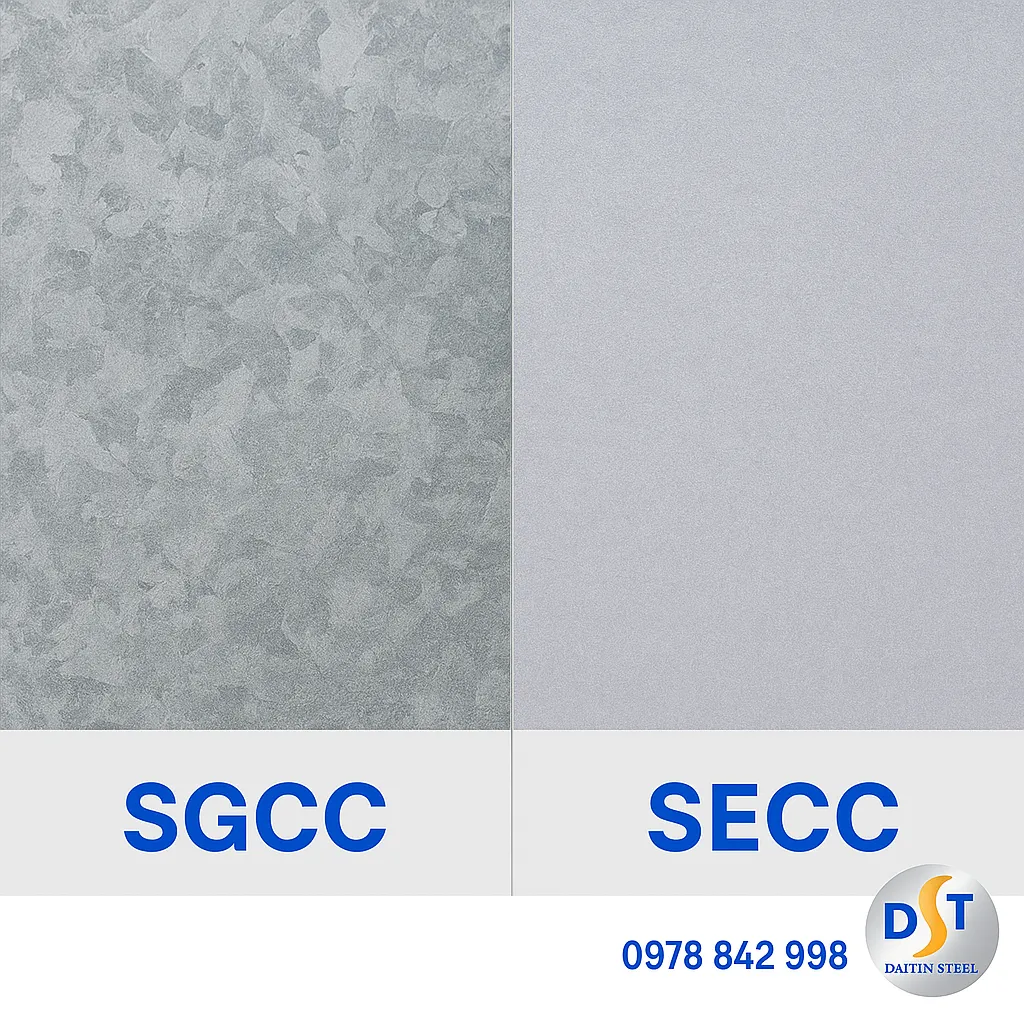
Although SECC (electro-galvanised steel) and SGCC (hot-dip galvanised steel) are both zinc-coated steel for corrosion resistance, but the difference in plating method leads to fundamental differences in microstructure, internal stress, and mechanical behavior during fabrication.
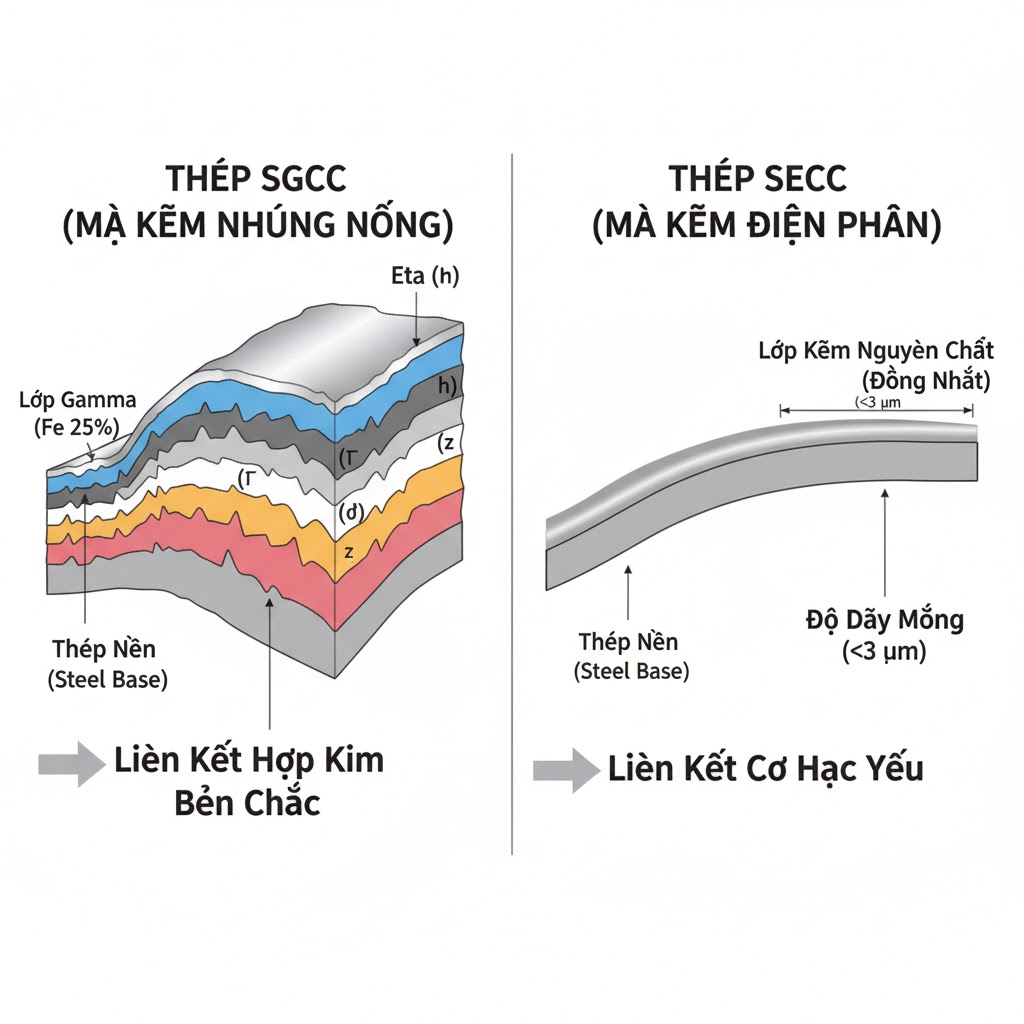
1. Differences in coating layer structure (Microstructure)
SECC is electroplated, with a fine crystalline zinc layer adhering directly to the steel substrate, forming almost no thick intermediate alloy layer. In contrast, SGCC forms multiple Fe-Zn alloy layers (Gamma, Delta, Zeta) between the steel and the outer zinc layer.
- SECC → thin, uniform, less brittle coating layer
- SGCC → thick coating layer, with brittle alloy zone → prone to cracking during deformation
2. Impact on mechanical properties during fabrication (Formability)
The presence of a brittle alloy layer in SGCC reduces ductile deformation capability. When bending or stamping:
- SGCC is prone to micro-cracks in the folded area
- SECC maintains coating continuity
This directly impacts long-term durability and corrosion resistance after fabrication.
3. Stress distribution and geometric stability
Due to the thick and non-uniform SGCC coating layer, the stress difference between the coating layer and the steel core is greater:
- Prone to warping during cutting/bending
- Higher deformation after fabrication
SECC has a thin and uniform coating layer → stable stress distribution → suitable for precision manufacturing.
4. Surface behavior in painting and finishing
The SGCC surface has a crystalline structure (spangle), causing uneven roughness. Meanwhile:
- SECC → smooth surface → even paint adhesion
- SGCC → prone to paint defects, uneven color
Comparison table of SECC vs SGCC in door manufacturing & mechanical engineering
| Criterion | SECC (EG steel sheet – electro-galvanised) | SGCC (Hot-dip galvanised) |
|---|---|---|
| Plating method | Electro-galvanised (Electroplating) | Hot-dip |
| Coating layer thickness | Thin (µm), precisely controlled | Thicker, less uniform |
| Coating layer structure | No thick alloy layer | Has brittle Fe-Zn alloy layer |
| Bending/stamping capability | Very good, less cracking | Prone to micro-cracks |
| Geometric stability | High, less warping | Lower, prone to deformation |
| Surface | Smooth, uniform | Has spangle, non-uniform |
| Paintability | Good adhesion, fewer defects | Prone to paint defects, pinhole |
| Fabrication precision | High (suitable for CNC, OEM) | Medium |
| Corrosion resistance | Medium (requires paint coating) | Higher (outdoor) |
| Suitable applications | Steel doors, electrical cabinets, precision mechanical parts | Outdoor structures, roofing, construction project |
Technical conclusion
The difference between SECC and SGCC is not about “which type is better”, but about “which type is suitable for the correct application”.
SECC is optimal for industrial manufacturing requiring high precision and stability, while SGCC is suitable for environments needing strong corrosion resistance but not requiring complex fabrication.
Core difference in material structure
1. SECC – Electro-galvanised (Electroplating)
- Thin zinc layer, controlled at micrometer level
- Uniform distribution across the entire surface
- Smooth surface, no spangle
Refer to details of Phu Cuong Steel Sheet's SECC products:
- EG electro-galvanised steel coil
- EG electro-galvanised steel sheet
- GA electro-galvanised steel coil
- GA electro-galvanised steel sheet
- Large width 1500mm electro-galvanised steel
2. SGCC – Hot-dip galvanising (Hot-dip)
- Much thicker zinc layer
- Has crystalline structure (spangle)
- Presence of brittle Fe-Zn alloy layer between steel substrate and coating layer
This alloy layer is the determining factor for most risks in mechanical fabrication.
Refer to Phu Cuong Steel Sheet's galvanised steel products:
Why is SECC more suitable for the door and mechanical engineering industries?
1. Geometric stability during fabrication
SECC has a more uniform stress distribution due to its thin and well-controlled coating layer. When performing operations such as cutting, bending, and stamping:
Conversely, SGCC is prone to deformation due to stress difference between the thick coating layer and the material core.
2. Better ductile deformation capability
As there is no thick and brittle Fe-Zn alloy layer, SECC withstands deformation better:
- Coating does not crack during bending
- Suitable for parts with many angles
- Maintains surface after fabrication
3. Optimal surface for powder coating
SECC's smooth surface helps:
- Even paint adhesion
- Reduces pinhole defects
- Increases product aesthetic appeal
Risks of using SGCC in steel door manufacturing
1. Warping after fabrication
When cutting or bending SGCC:
- Internal stress is unevenly released
- The steel sheet slightly bends or twists
In door manufacturing, small deviations can lead to:
- Doors not sealing properly
- Misaligned frames
- Requires manual adjustment
See more detailed article here: EG steel sheet in the door & mechanical engineering industries: Why do fabrication businesses prioritize using it?
2. Coating cracks → corrosion from within
SGCC's brittle alloy layer easily cracks during bending:
- Creates pathways for oxygen and moisture
- Causes rust at folded edges
- Reduces product lifespan
3. Mass production paint defects
SGCC's uneven surface causes:
- Uneven paint adhesion
- Inconsistent color
- Increases defect rate in mass production
4. Accumulated errors in the production line
When material is unstable:
- Errors appear at each stage
- Accumulate during assembly
- Leads to mass defects
When to use SGCC?
SGCC still has advantages in applications:
- Outdoor environments
- High corrosion resistance requirements
- Does not require high precision during fabrication
Therefore, material selection should be based on intended use, not just on price.
Refer to applications of different steel types by purpose here: Comparison of EG Steel Sheet, GA, Galvanised, Cold-Rolled Steel, Hot-Rolled – How Are They Different?
Conclusion table: Should you choose SECC or SGCC?
| Use case | Material recommendation | Technical reason |
|---|---|---|
| Steel door manufacturing (room doors, industrial doors) | SECC (EG steel sheet) | High precision, less warping, good surface finish, stable paint adhesion |
| Fabrication of electrical cabinets, machine casings, mechanical equipment | SECC | Easy to bend and stamp, coating does not crack, suitable for mass production |
| Production requiring tight tolerances (CNC, OEM) | SECC | Stable thickness, reduces accumulated errors |
| Outdoor structures (roofs, frames, construction projects) | SGCC | Thick coating, better corrosion resistance in harsh environments |
| Products not requiring high aesthetics | SGCC | Lower cost, does not require high surface finish |
| Prioritize low material price (short-term) | SGCC | Lower input price but requires accepting fabrication risks |
| Prioritise quality & production stability (long-term) | SECC | Reduce mass defects, optimise total production costs |
Conclusion
SECC and SGCC are not simply two different types of galvanised steel sheet, but two material solutions serving two different purposes. In the steel door and precision engineering industry, SECC is the optimal choice due to its stability, good fabrication capability, and reduced production risks.
Tôn Thép Phú Cường – Stable material solution for door & engineering production
In actual steel door and engineering production, most defects do not come from machinery but from input materials. Small deviations in thickness, stress, or surface can lead to warping, paint defects, or accumulated errors throughout the entire production line.
Tôn Thép Phú Cường focuses on solving this problem by providing a stable batch material source, especially EG (SECC) steel sheet – suitable for manufacturing businesses requiring high precision and repeatability in fabrication.

Practical solution for door and engineering workshops
- EG (SECC) steel sheet smooth surface, uniform thickness → reduces bending, stamping, painting defects
- GA steel sheet, galvanised steel sheet from genuine blank sources → controls input quality
- Diverse steel sheet widths, especially from 1500mm+ → optimises cutting layout, reduces material loss
Fabrication at warehouse – reduces errors from the start
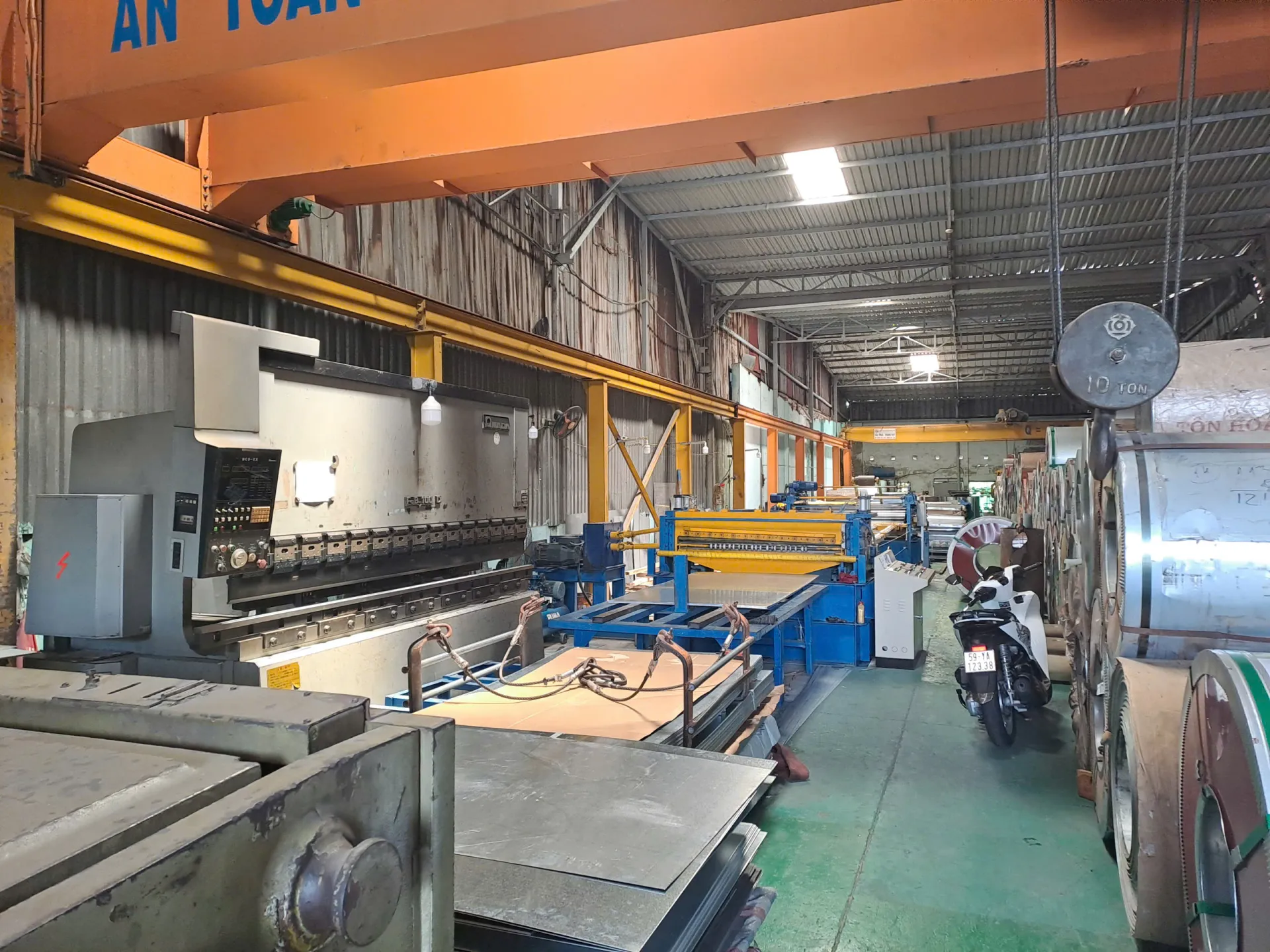
Phu Cuong owns a system of coil slitting – bending-stamping – cutting to specification machines, allowing material processing directly at the warehouse:
- Cut to exact dimensions according to drawing → reduces input errors
- Limits deformation due to transport or re-fabrication
- Suitable for mass production requiring high stability
Proactive delivery – ensures production schedule
- Owns private trucks → not dependent on shipping companies
- Fast delivery, handles urgent orders within the day
- Ensures continuous supply for production workshops
Long-term cooperation orientation
Tôn Thép Phú Cường not only supplies materials, but aims to become a partner accompanying door and engineering businesses in:
- Reduce defect rate
- Stabilise product quality by batch
- Optimise total production costs (not just material price)
Tôn Thép Phú Cường – Accompanying all construction projects, where quality builds the brand.
Contact information:
Address: 2177C – 2177D National Highway 1A, Dong Hung Thuan Ward, District 12, HCMC
Hotline: 0933 919 899 (Ms. Anh)
Email: tonthepphucuong@gmail.com
Website: tonthepphucuong.com
See more related articles:
- EG steel sheet in the door & engineering industry: Why do fabrication businesses prioritise its use?
- Steel Sheet Bending Service According to Drawing In District 12, HCMC – Precise, Uniform Fabrication, Fast Delivery
- Hoa Sen Galvanised Z120: Characteristics, Applications And Notes When Using
- Why is it that electro-galvanised steel sheet has different paint adhesion? A perspective from surface, coating, and fabrication process