What is CQ in the steel industry? Distinguish between CQ and CO to avoid acceptance risks
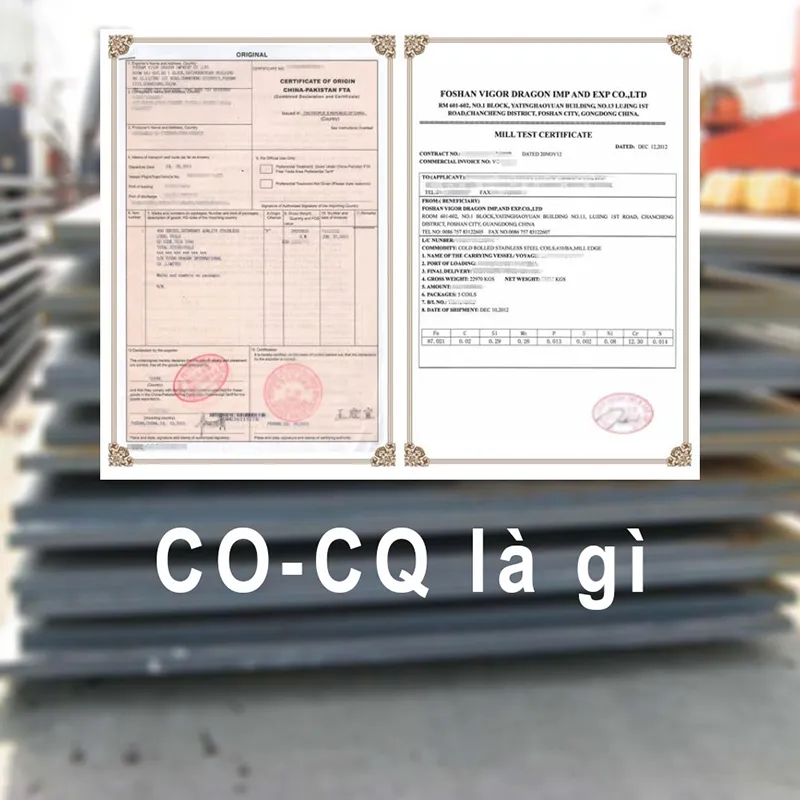
1. What is CQ in the steel sheet industry?
CQ stands for Certificate of Quality – Certificate of Quality. In the steel sheet industry, CQ is a document issued by legal manufacturer or supplier issued, to confirm that the steel sheet product meets the published technical standards.
If CO answers the question “Where is this steel sheet manufactured?” then CQ answers the equally important question: “Does this steel sheet meet technical quality standards?”
CQ does not signify origin, but focuses on technical specifications such as:
- Actual thickness of the steel sheet
- Type of base steel
- Coating layer (galvanised, electro-galvanised…)
- Applied manufacturing standard
- Related mechanical properties
In industrial construction projects, CQ is the basis for supervising consultants and investors to evaluate whether the material matches the design requirements.
2. Why is CQ especially important in steel sheet acceptance inspection?
In actual construction, it is very rare for each steel sheet to be taken for independent testing. Instead, CQ is precisely the “technical representative” for the entire shipment.
CQ helps:
- Compare actual material with design drawings
- Confirm steel sheet meets committed technical standards
- Serve as a basis for incoming material acceptance inspection
- For as-built documentation and final settlement
Many construction projects face acceptance inspection delays not because of poor quality steel sheet, but because CQ is unclear, does not match, or lacks information.
3. Mandatory content in a valid steel sheet CQ
A steel sheet CQ meeting requirements usually includes the following content:
- Steel sheet product name
- Nominal thickness and permissible tolerance
- Type of coating layer (galvanised, electro-galvanised…)
- Coating mass (e.g. Z180, Z275…)
- Applied manufacturing standard (TCVN, JIS, ASTM…)
- Lot number, manufacturing date
The more detailed the CQ, the higher the likelihood of smooth acceptance inspection. Conversely, a brief or vague CQ is a sign to be cautious.
4. Distinguish between CQ and CO – why they cannot be used interchangeably?
One of the most common mistakes is to assume that: “Having CQ is enough, no need for CO”. This is a completely wrong view in many cases.
Core differences:
- CQ: confirms technical quality
- CO: confirms origin
CQ does not prove the legality of origin, while CO does not reflect quality details. Therefore, in large construction projects, CQ and CO always go hand in hand.
Many contractors have faced risks when only having CQ but no CO, leading to insufficient legal documents during audits.
5. Technical standards commonly found in steel sheet CQ
CQ often cites production standards to prove quality. Some common standards in the steel sheet industry include:
- TCVN – Vietnamese Standard
- JIS – Japanese Industrial Standard
- ASTM – American Standard
- EN – European Standard
Each standard has different regulations regarding thickness, tolerance, coating layer, and mechanical properties. Understanding CQ helps contractors know exactly the material they are using.
6. Actual risks when CQ is incorrect or incomplete
In practice, many risks occur around CQ:
- CQ states nominal thickness but does not state tolerance
- CQ does not match the invoice or shipment
- Blurred CQ photo, unclear issuing source
- CQ is generic, lacking applicable standards
The consequences are often:
- Required to supplement or redo documents
- Delayed acceptance, delayed payment
- Disputes arise between parties
7. Is CQ mandatory for all construction projects?
In principle, CQ is not always mandatory for small, civil construction projects. However, in the following cases, CQ is almost a default requirement:
- Factories, industrial zones
- Construction projects with independent supervision consultants
- Projects requiring strict acceptance
- Construction projects with significant capital
Even when not required, having CQ still helps contractors be more proactive and technically secure.
8. How does CQ affect the decision to choose steel sheet?
At the same price, two types of steel sheet with different CQs will result in different quality and lifespan of the construction project.
CQ helps contractors:
- Compare materials transparently
- Avoid buying under-thickness steel sheet
- Control input quality
Professional contractors often request CQ right from the quotation stage.
9. How contractors effectively check CQ for steel products
To limit risks, contractors should:
- Cross-reference CQ with contract and quotation
- Compare CQ with actual delivered goods
- Request original CQ or certified copy
- Store CQ by batch
Checking CQ does not take much time but helps avoid major consequences later on.
10. Role of the supplier in ensuring CQ
Not every contractor has deep expertise to read CQ. Therefore, the role of the supplier is very important.
Soft promotion: Phu Cuong Steel Products – Accompanying Every Construction Project. Phu Cuong commits to providing clear, transparent CQ for each batch of galvanised steel sheet, electro-galvanised steel sheet EG – GA. The technical team, knowledgeable about standards, helps customers easily cross-reference and accept.
11. Conclusion
CQ is an important technical foundation in the steel products industry. Properly understanding CQ, clearly distinguishing it from CO, and requesting it fully from the beginning will help contractors avoid many risks throughout the construction project lifecycle.