What is Steel Sheet Flatness Tolerance? Impact on Fabrication and Practical Installation
1. Introduction: Why is steel sheet flatness important?
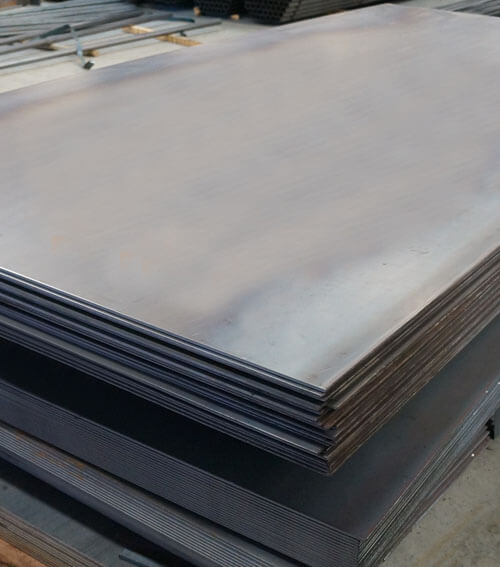
In the mechanical engineering and construction industry, many people often pay attention to thickness, coating layer or steel sheet width while overlooking an extremely important factor: flatness of the steel sheet. In reality, a steel sheet, even if the thickness is correct but is warped, can still cause a series of problems in fabrication and installation.
Especially for applications requiring high precision such as laser cutting, bending and stamping, or metal structure fabrication, flatness deviation can directly affect product quality and construction project progress.
2. What is steel sheet flatness tolerance? (In-depth technical analysis)
In mechanical and material engineering, flatness tolerance is not simply whether the steel sheet “is curved or not”, but is a geometric quantity that is clearly defined.
Essentially, the flatness of a steel sheet is determined by the maximum distance between two imaginary parallel planes such that the entire surface of the steel sheet lies neatly between these two planes.
Important to understand:
- Does not consider whether the steel sheet is tilted or misaligned
- Only considers the intrinsic convexity – concavity of the surface
This is a point often confused with other concepts:
- Flatness: internal surface deviation of the sheet
- Overall curvature: sheet bent along its length
- Twist: sheet twisted along its diagonal axis
2.1. How to determine flatness tolerance in practice
In technical measurement, flatness is usually determined by the height difference between points on the surface:
Flatness deviation = highest point – lowest point
This value can be expressed in several forms:
- In absolute units: mm (e.g.: ≤ 3mm)
- As a ratio: percentage of length or width (e.g.: ≤ 0.2%)
Allowable tolerance will depend on:
- Steel sheet thickness (the thinner the steel sheet, the easier it is to bend)
- Sheet width (larger width is harder to control)
- Production method (hot-rolled, cold-rolled)
2.2. Types of commonly encountered flatness deviation
In actual production and fabrication, unacceptable flatness often appears in various forms:
- Edge wave: the two edges of the steel sheet are wavy
- Bulging in the middle: the central part is raised or recessed
- Local indentations and protrusions: surface unstable when light force applied
- Sheet twisting: two corners not on the same plane
Each of these forms reflects a common problem: stress distribution in the material is uneven.
2.3. Physical nature: residual stress in the material
This is the core factor determining the flatness of the steel sheet.
During the rolling process, the steel sheet is deformed under very high force. However, this force is not distributed completely evenly across the entire cross-section:
- The outer layer may be stretched more
- The inner layer is compressed or less deformed
After the rolling process is complete, the material tends to “recover” but unevenly, leading to the appearance of residual stress.
When this stress is unbalanced:
- Stretched areas will contract
- Compressed areas will expand
The direct consequence is:
- The steel sheet is bent
- The surface appears wavy
- Loss of standard flatness
For large width steel sheet (from 1500mm upwards), this phenomenon is more pronounced because:
- Large stress distribution distance
- Bending stiffness decreases with width
2.4. Common mistakes when assessing flatness
- Placing steel sheet on an unstandardized surface → inaccurate measurement results
- Visual assessment → inaccurate
- Confusion between overall bending and surface deviation
- Failure to inspect before mass fabrication
These mistakes can lead to:
- Mass errors during cutting or bending
- Dimensional errors after fabrication
- Increase repair costs and construction time
2.5. Practical perspective for contractors and mechanical workshops
Important point to remember is:
Flatness is not “yes or no”, but “whether the degree of deviation is within permissible limits or not”.
Correct understanding of this concept helps:
- Set clear technical requirements when purchasing materials
- Control input quality
- Avoid disputes with suppliers
3. Causes of flatness deviation
3.1. Residual stress during rolling
During the steel rolling process, uneven deformation forces can create residual stress within the material. When released, the steel sheet tends to bend or twist.
3.2. Errors during uncoiling
For coiled steel sheet, if the uncoiling process is not technically correct (uneven pulling force, non-standard rollers), the steel sheet after uncoiling will be wavy.
3.3. Influence of ambient temperature
High temperatures or sudden temperature changes can cause uneven expansion, especially with large width steel sheet.
3.4. Transportation and storage
Improper stacking or placing on an uneven surface also causes steel sheet deformation over time.
In addition, this also causes steel scratches, see more articles here Why steel sheet gets scratched during transportation and effective solutions
4. Practical applications and flatness requirements
Flatness requirements will vary depending on the application:
- CNC Laser cutting: requires high flatness to ensure accurate focal length
- Bending and stamping: if the steel sheet is bent, it will cause bending angle deviation (Refer to the article What Is Springback When Bending Steel Sheet? Why Is The Finished Product Still Wrong Even When Bent At The Correct Angle On The Machine)
- Workshop erection: non-flat steel sheet easily causes open joints
- Manufacturing doors, metal furniture: directly affects aesthetics
Especially, with large width steel sheets (1500mm or more), flatness errors are more likely to occur if not well controlled.
5. Risks when using steel sheet not meeting flatness requirements
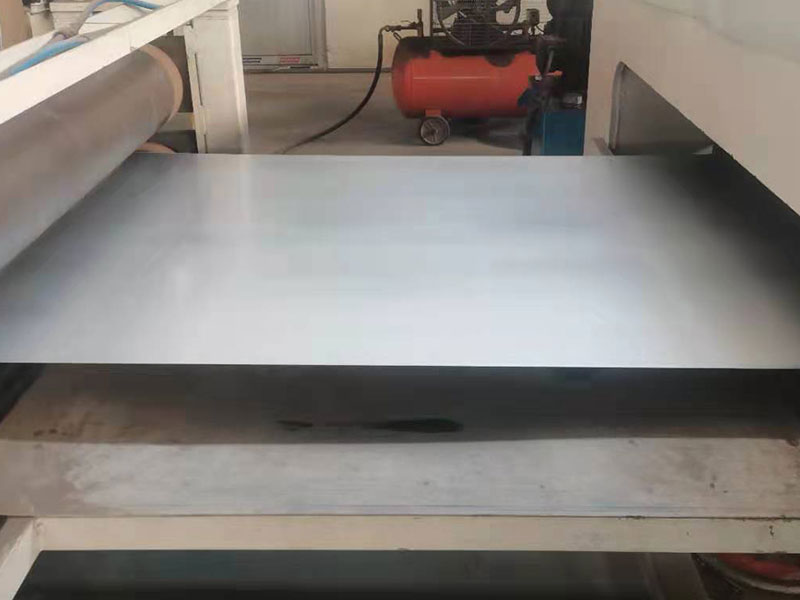
- Dimensional deviation after fabrication
- Difficult to assemble, requires manual adjustment
- Increase labor costs and construction time
- Reduce structural durability due to uneven force distribution
- Affects product aesthetics
In large construction projects, these small deviations can accumulate and cause very large costs.
6. Effective flatness control solutions
6.1. Selecting materials from reputable suppliers
The quality of input blanks directly determines the flatness of the steel sheet. Large manufacturers typically have better control over the rolling process and residual stress, thereby making materials more stable when put into fabrication.
In practice, many mechanical workshops encounter situations where the steel sheet is slightly bent from the start, even though thickness specifications are correct. The cause often comes from inconsistent material sources or a lack of strict control over geometric tolerances.

Therefore, the selection of a supplier should not only be based on price, but also consider overall quality control capabilities, especially factors such as flatness, material stability, and processing procedures before delivery.
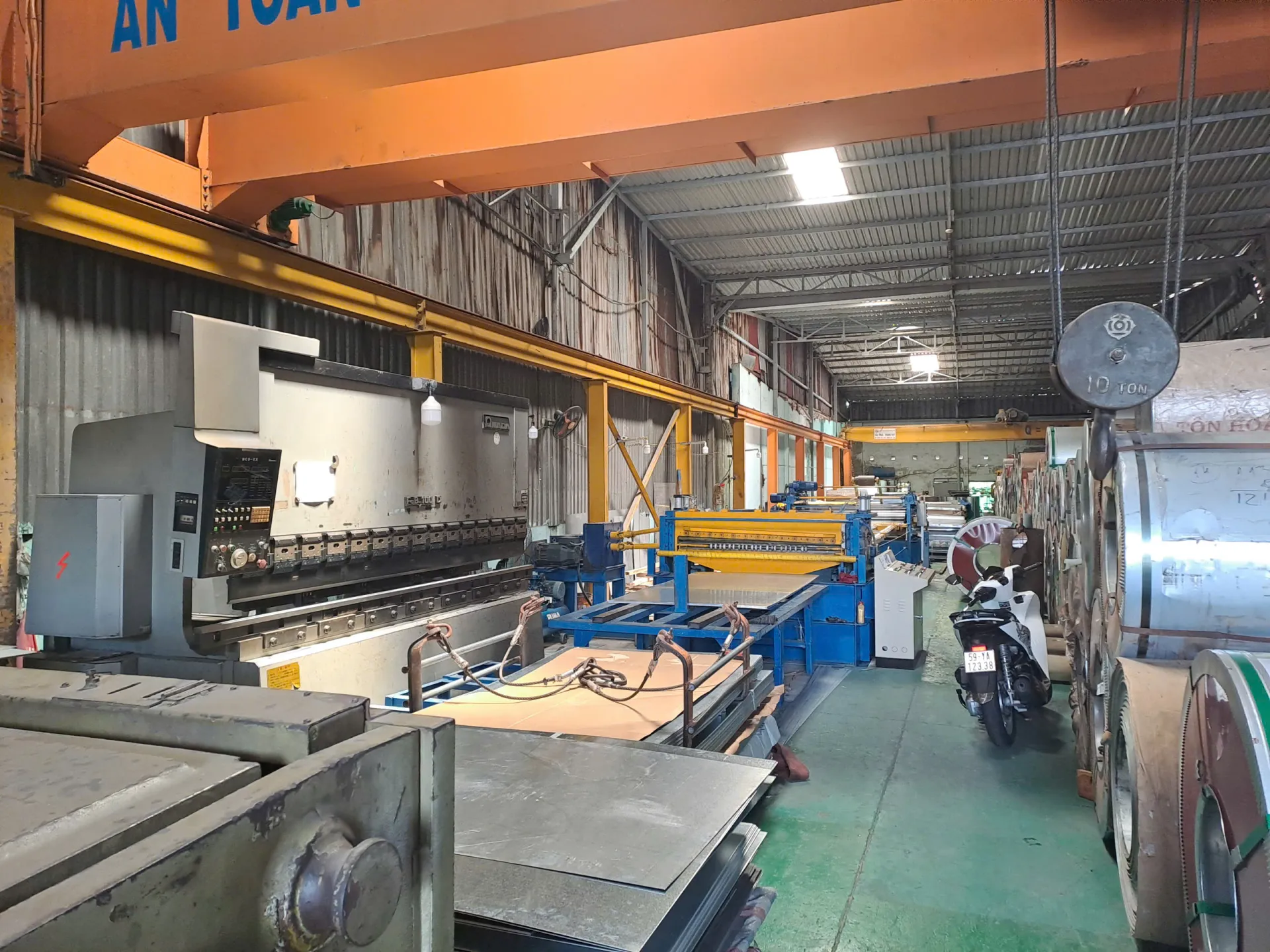
Some suppliers have an advantage when they both supply materials and perform coil slitting and cutting to specification in-warehouse with synchronized machinery systems. This helps minimize deformation occurring during intermediate processes, while ensuring that the steel sheet achieves a more stable state before being put into actual production.
6.2. Coil slitting fabrication with correct technique
System modern coil slitting machine with precision leveling rollers helps minimize wavy edges after cutting.
6.3. Inspection before production
Random inspection of the flatness of the batch is recommended to avoid risks during mass fabrication.
6.4. Proper storage
Steel sheet should be placed on a flat surface with appropriate supports to prevent deformation during storage.
7. Conclusion
Flatness tolerance is an important technical factor but often overlooked. Good flatness control not only helps improve product quality but also optimizes costs and construction project schedule.
8. Phu Cuong Steel – Leading Reputable Large Width Steel Sheet Distributor
Phu Cuong Steel supplies key product lines such as galvanised steel sheet, EG steel sheet, GA steel sheet in various specifications, especially large widths from 1000mm, 1250mm to 1500mm, helping reduce material waste in construction.
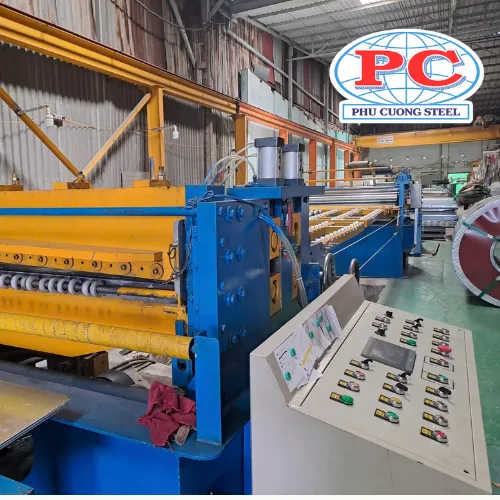
With modern machinery systems, Phu Cuong provides services for coil slitting, cutting to specification, bending and stamping, in-warehouse fabrication, ensuring high accuracy and limiting warping.
The company owns its own trucks and proactively manages transportation, helping optimize logistics costs and fast delivery to customers in Ho Chi Minh City and surrounding areas.
Contact information:
Address: 2177C–2177D National Highway 1A, Dong Hung Thuan Ward, District 12, Ho Chi Minh City
Phone: 0933 919 899
Email: tonthepphucuong@gmail.com
Website: tonthepphucuong.com
See more related articles:
- Why does paint adhesion differ even if it's the same electro-galvanised steel sheet? A perspective from surface, coating, and fabrication process
- What is steel sheet bending fabrication? Process, advantages, and practical applications
- How to Measure Galvanised Coating Layer On Construction Project Site: Avoid Errors When Inspecting Z100, Z180, Z275
- EG steel sheet in mechanical engineering, doors, and metal furniture: Why do many workshops prioritize choosing it?