Steel Sheet and Steel Materials Used in Mechanical Manufacturing Industry – Which Type Should Be Chosen for Precision Fabrication
Role of steel sheet materials in mechanical engineering manufacturing
Mechanical engineering manufacturing uses many types of sheet and coil metal materials, among which the most common are galvanised steel sheet, electro-galvanised steel sheet, cold-rolled steel, and hot-rolled steel. Choosing the right material not only affects product durability but also determines fabrication accuracy, weldability, paintability, and production costs.
In mechanical workshops, materials often undergo many stages such as laser cutting, CNC, bending, stamping, forming, welding, painting, or plating. Each type of steel sheet will be suitable for a different purpose.
Common types of steel sheet used in mechanical engineering manufacturing
1) What is cold-rolled steel (CR – Cold Rolled Steel)?
Cold-rolled steel (Cold Rolled Steel – CR) is a type of steel produced by re-rolling hot-rolled steel at room temperature to increase dimensional accuracy, improve surface finish, and increase material hardness. After the cold-rolling process, the steel has a smooth surface, high flatness, small tolerance, and is easy for precision mechanical fabrication.
In mechanical engineering manufacturing, cold-rolled steel is a very commonly used material for parts requiring high precision, a beautiful surface, and good bending and stamping capabilities.

Cold-rolled steel production process
Cold-rolled steel is produced from hot-rolled steel (HR). After the hot-rolled steel is cleaned of its oxide layer, the material is passed through a rolling system at room temperature to reduce thickness and increase hardness.
Main steps:
- Hot-rolled → initial blank creation
- Acid pickling
- Cold-rolled to reduce thickness
- Annealing
- Skin pass rolling
- Anti-rust oil coating
After this process, cold-rolled steel has much higher precision than hot-rolled steel.
Technical characteristics of cold-rolled steel
- Smooth surface, few defects
- High flatness
- Small thickness tolerance
- Higher hardness than hot-rolled steel
- Easy to bend, stamp, form, laser cut
- Suitable for electrostatic painting
Because of these characteristics, cold-rolled steel is often used in industries requiring high precision such as mechanical engineering manufacturing, equipment manufacturing, electrical – electronics, and supporting industries.
See detailed cold-rolled steel product information here: OILED STEEL SHEET - COLD-ROLLED STEEL SHEET (CR)
Common cold-rolled steel grades
Some common cold-rolled steel grades:
- SPCC
- SPCD
- SPCE
- DC01
- DC03
- DC04
Each steel grade will have different ductility and hardness, suitable for specific types of fabrication such as deep drawing, bending, forming, or CNC fabrication.
Applications of cold-rolled steel in mechanical engineering manufacturing
Cold-rolled steel is widely used in mechanical products and industrial equipment.
- Machine casing
- Electrical cabinet
- Mechanical equipment
- Stamped parts
- CNC fabrication
- Laser fabrication
- Machine frame
- Electrical equipment
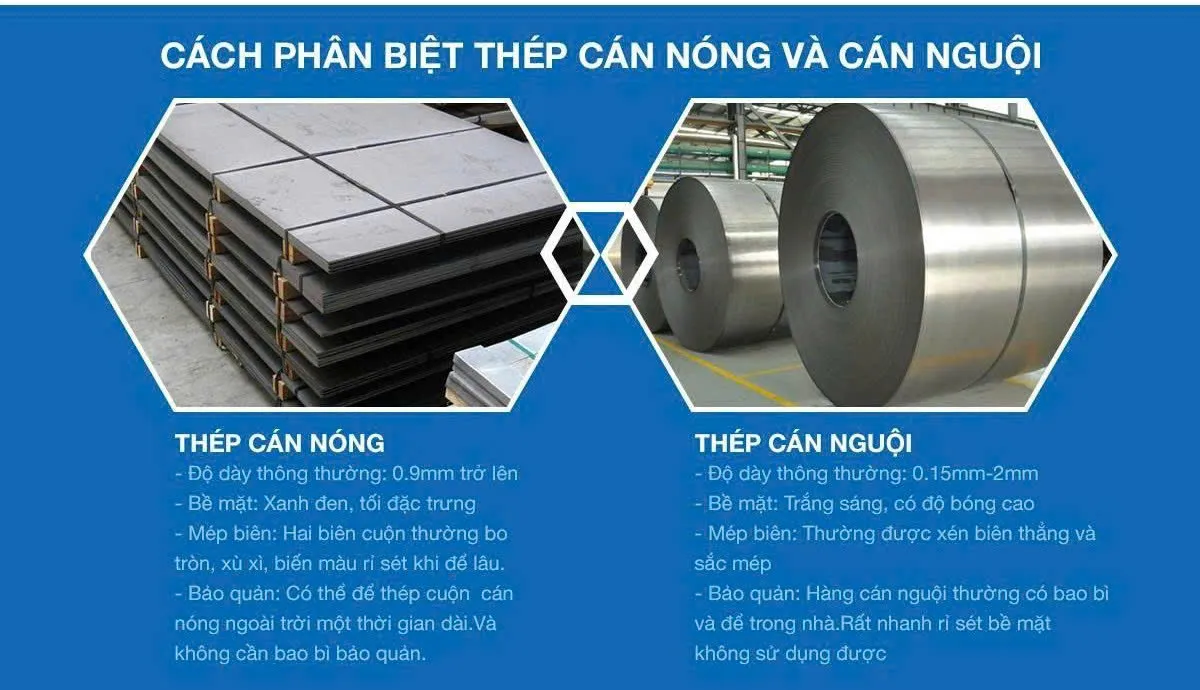
Comparison of cold-rolled steel and hot-rolled steel
| Criterion | Cold-rolled | Hot-rolled |
|---|---|---|
| Surface | Smooth | Rough |
| Accuracy | High | Low |
| Hardness | High | Lower |
| Fabrication | Easy to bend and stamp | Used for structures |
| Application | Precision mechanics | Structures |
Notes when choosing cold-rolled steel for fabrication
When choosing cold-rolled steel, pay attention to:
- Choose the correct steel grade
- Choose the correct thickness
- Check flatness
- Check surface
- Prioritize materials with CO CQ
In addition, it is advisable to choose a supplier that can slit coil, cut sheets, and deliver according to specifications to ensure the material matches the drawing.
Electro-galvanised steel (Electro Galvanized Steel – EG / SECC) in mechanical engineering manufacturing
Electro-galvanised steel is a type of steel coated with a thin layer of galvanised by electroplating to increase corrosion resistance and improve the material's surface. Unlike hot-dip galvanised steel sheet, the coating of electro-galvanised steel is thinner but has very high uniformity, a smooth, beautiful surface, and is easy to fabricate.
In mechanical engineering manufacturing, electro-galvanised steel is a very commonly used material for products requiring high precision, a beautiful surface, easy painting, and easy bending and stamping.
What is EG (nhũ xanh) electro-galvanised steel?
EG electro-galvanised steel, also known as EG steel, is a type of electro-galvanised steel with a characteristic blue anti-rust coating on the surface. This coating is usually a passivation layer (chromate) that helps increase oxidation resistance and protect the galvanised layer.
EG steel is usually denoted as:
- SECC
- SECD
- SECE
- EG Steel
- Electro Galvanized Steel
This material is widely used in precision engineering, electrical cabinet manufacturing, equipment, machine casings, components, and parts requiring a good surface finish.
For more details on EG steel (green)/EG steel sheet, you can refer to the comprehensive A-Z article here: What is EG Steel Sheet? SECC, EG, EG Steel – A–Z Overview & Applications in District 12
Electro-galvanised steel sheet production process
Electro-galvanised steel sheet is produced from cold-rolled steel. After cold-rolling, the steel is fed into an electrolysis bath to apply a galvanised layer to the surface.
Main steps:
- Cold-rolled steel → cleaning
- Electro-galvanising
- Washing and surface treatment
- Passivation for rust prevention
- Anti-oxidation oil coating
Thanks to this process, the coating is very uniform, thickness is precise, and the surface is very good.
Characteristics of EG steel sheet (green)
- Smooth, bright surface
- High precision
- Low warping
- Easy to form and stamp
- Easy to electrostatic paint
- Low scratch susceptibility
- Good rust resistance in indoor environments
Due to these characteristics, EG steel sheet is often preferred in mechanical products with high technical requirements.
Applications of EG steel sheet in mechanical engineering
- Electrical cabinets
- Machine casings
- Electrical equipment
- Mechanical components
- CNC fabrication
- Laser fabrication
- Forming and stamping
- Industrial equipment
View electro-galvanised steel sheet (green/grey) product details here: ELECTRO-GALVANISED STEEL SHEET – EG – GA
Comparison of electro-galvanised steel sheet and galvanised steel sheet
| Criteria | Electro-galvanised | Hot-dip galvanised |
|---|---|---|
| Coating thickness | Thin | Thick |
| Surface | Good, smooth | Spangle |
| Precision | High | Medium |
| Mechanical fabrication | Very good | Medium |
| Outdoor rust resistance | Medium | Good |
| Applications | Electrical cabinets, mechanical | Structures, workshops |
Notes when choosing electro-galvanised steel sheet for fabrication
- Choose the correct SECC / EG grade
- Choose the correct thickness
- Check the surface
- Check flatness
- Prioritise materials with CO CQ
Additionally, choose a supplier that can slit coil, cut sheets, and supply wide widths to reduce waste during fabrication.
Galvanised steel sheet (SGCC – GI)
Galvanised steel sheet has a thick coating, good rust resistance, suitable for outdoor parts or humid environments. This material is widely used in structures, frames, supports, and parts that do not require a very good surface finish.
Applications:
- Steel frames
- Structures
- Supports
- Workshops
- Mechanical fabrication
View galvanised steel sheet product details here: GALVANISED STEEL SHEET (SGCC - SECC)
Hot-rolled steel (HR – Hot Rolled Steel)
Hot-rolled steel has a low cost, large thickness, suitable for load-bearing parts or structures. However, the surface is not as good as cold-rolled steel.
Applications:
- Machine structures
- Chassis
- Base plate
- Load-bearing component
How to choose suitable material based on fabrication method
Laser cutting / CNC
Use cold-rolled steel or electro-galvanised steel sheet to ensure accuracy and clean cut edges.
Bending and stamping
Use cold-rolled steel or electro-galvanised steel to prevent cracking and warping.
Outdoor fabrication
Use galvanised steel sheet for corrosion resistance.
Load-bearing structure
Use hot-rolled steel.
Phu Cuong Steel – Material Supplier for Mechanical Workshops in Ho Chi Minh City
Phu Cuong Steel specializes in supplying galvanised steel sheet, EG electro-galvanised steel sheet, GA, cold-rolled steel, and steel plate for mechanical workshops, factories, construction projects, and fabrication units in Ho Chi Minh City.
Advantages:
- Available in various specifications
- Available in widths up to 1500mm
- Cut to order
- Coil slitting at warehouse
- Bending and stamping according to drawings
- Fast delivery
Phu Cuong Steel – Partnering with every construction project
- Address: 2177C – 2177D QL1A, Dong Hung Thuan, District 12
- Hotline: 0933 919 899
- Website: tonthepphucuong.com
See more related articles:
- Where to Buy Wide Steel Sheet in District 12? Experience in Choosing the Right Steel Sheet for Construction Projects
- What is Z275 galvanised steel sheet? Should Z275 be used for all construction projects?
- What is GA electro-galvanised steel sheet? Structure, SECC – GA standards, and industrial applications