What is Residual Stress in Steel? Why does the steel sheet warp after cutting?
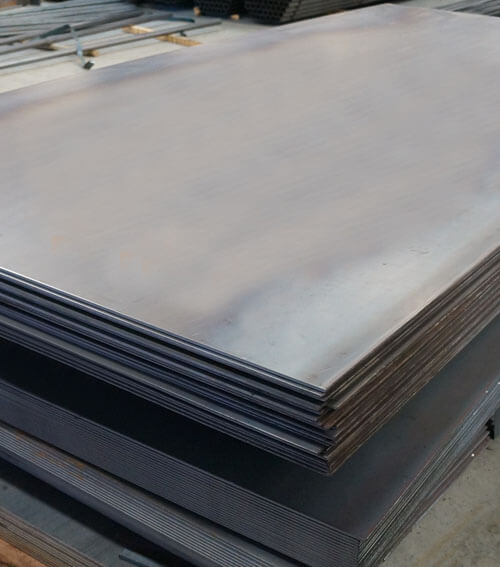
1. Introduction: Why does flat steel sheet curve after cutting?
In actual fabrication, many units encounter a situation where steel sheet is flat in coil form, but after uncoiling or cutting into sheets, warping appears. This is not a random error but stems from an important technical factor: residual stress in the material.
Residual stress is a "hidden" cause but directly affects fabrication quality, especially in precision mechanics, steel structures, and industrial production.
2. Residual stress in steel from a material mechanics perspective
Residual stress is not merely "remaining force in the material," but is the result of uneven strain distribution during processing and metal phase transformation.
In steel sheet, residual stress often exists in the form of:
- Tensile residual stress on the surface layer
- Compressive residual stress in the inner layer
This distribution is formed due to differences in:
- Cooling rate between the surface and the core of the material
- Degree of plastic deformation during rolling
- Uneven recovery and recrystallization phenomena
Especially in cold-rolled steel, a high degree of plastic deformation accumulates strain energy in the crystal lattice (dislocation density increases). When not thoroughly heat-treated, this energy exists as intrinsic residual stress.
2.1. Role of crystal structure and plastic deformation
When steel is deformed during rolling:
- Slip planes in the crystal are activated
- Dislocation increases sharply
- Crystal structure is "locked" in an unbalanced state
This creates a state where the material always tends to "release energy" to return to a more stable state.
→ This tendency is the root cause of warping after cutting.
2.2. Influence of plating process (galvanised, electro-galvanised)
In plated steel sheets (hot-dip galvanised or electro-galvanised), residual stress is also affected by:
- Difference in thermal expansion coefficient between the plating layer and the steel substrate
- Cooling process after plating
- Adhesion and thickness of the plating layer
For example:
- Plating layer cools faster → shrinks more strongly
- Steel substrate shrinks slower
→ creates tensile stress on the surface and compression inside → increases the risk of curving when cut.
3. Mechanism of stress release during fabrication
3.1. "False equilibrium" state before cutting
In the initial state (coil form or large sheet), residual stresses are symmetrically distributed and cancel each other out on a macroscopic scale, giving the material a "flat" feel.
However, this is only metastable equilibrium, not a truly stable state.
3.2. Breaking equilibrium – releasing elastic energy
When performing operations such as:
- Uncoiling
- Sheet cutting
- Laser fabrication or bending
→ the system is cut apart → stress distribution is no longer symmetrical.
At that point:
- The part with tensile stress will expand
- The part with compressive stress will contract
→ creating immediate warping deformation.
3.3. Energy perspective (important)
Essentially, materials always tend to:
- Reduce internal energy
- Achieve the lowest stable state
Residual stress is "stored energy." When released (due to cutting), the material deforms itself to reduce this energy.
→ warping is not a random error, but an inevitable physical consequence.
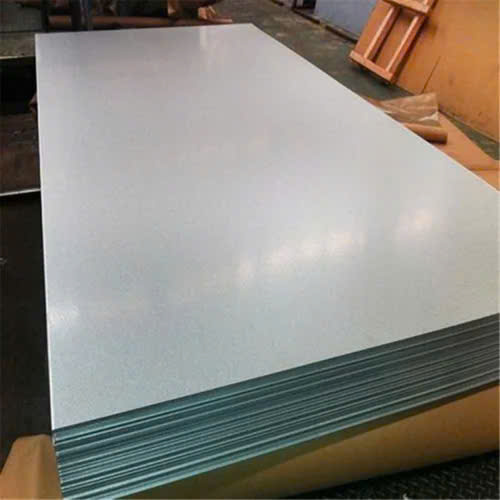
3.4. Why do thin steel sheets curve more easily?
According to material mechanics, the bending stiffness of a steel sheet is proportional to:
thickness^3 (t³)
This means:
- Just a slight reduction in thickness → stiffness decreases very sharply
- Thin steel sheets will deform more easily when stress is released
→ this is why thin steel sheets or electro-galvanised steel sheets are often more sensitive to warping.
4. Practical application: When does residual stress cause major problems?
- CNC laser cutting: material deformation causes cutting errors
- Metal bending: incorrect angles, unable to maintain profile
- Structural fabrication: inaccurate assembly
- Mass production: cumulative deviations
In many cases, businesses mistakenly believe that the material is "poor quality," while the real reason is uncontrolled residual stress.
5. Consequences of not controlling residual stress
- Increased scrap rate
- Time-consuming manual adjustments
- Impact on production schedule
- Reduced product accuracy
Especially for orders requiring tight tolerances, residual stress can become a factor that “breaks the plan” for the entire production process.
6. Solutions for controlling residual stress and limiting warping
6.1. Material inspection from the start
Before fabrication, it is necessary to conduct a preliminary check of material flatness and stability. In many cases, skipping this step leads to errors only being detected after cutting or bending, incurring repair costs.
In addition to flatness, businesses should also check actual galvanised coating at the construction project to ensure the material meets technical standards.
6.2. Stress control from the slitting and cutting stage
Residual stress only becomes a problem when released uncontrollably. Therefore, the slitting and cutting stage plays an extremely important role in limiting warping.
Factors to control include:
- Tension stability during slitting
- Accuracy of the cutting system
- Processing speed suitable for each material type
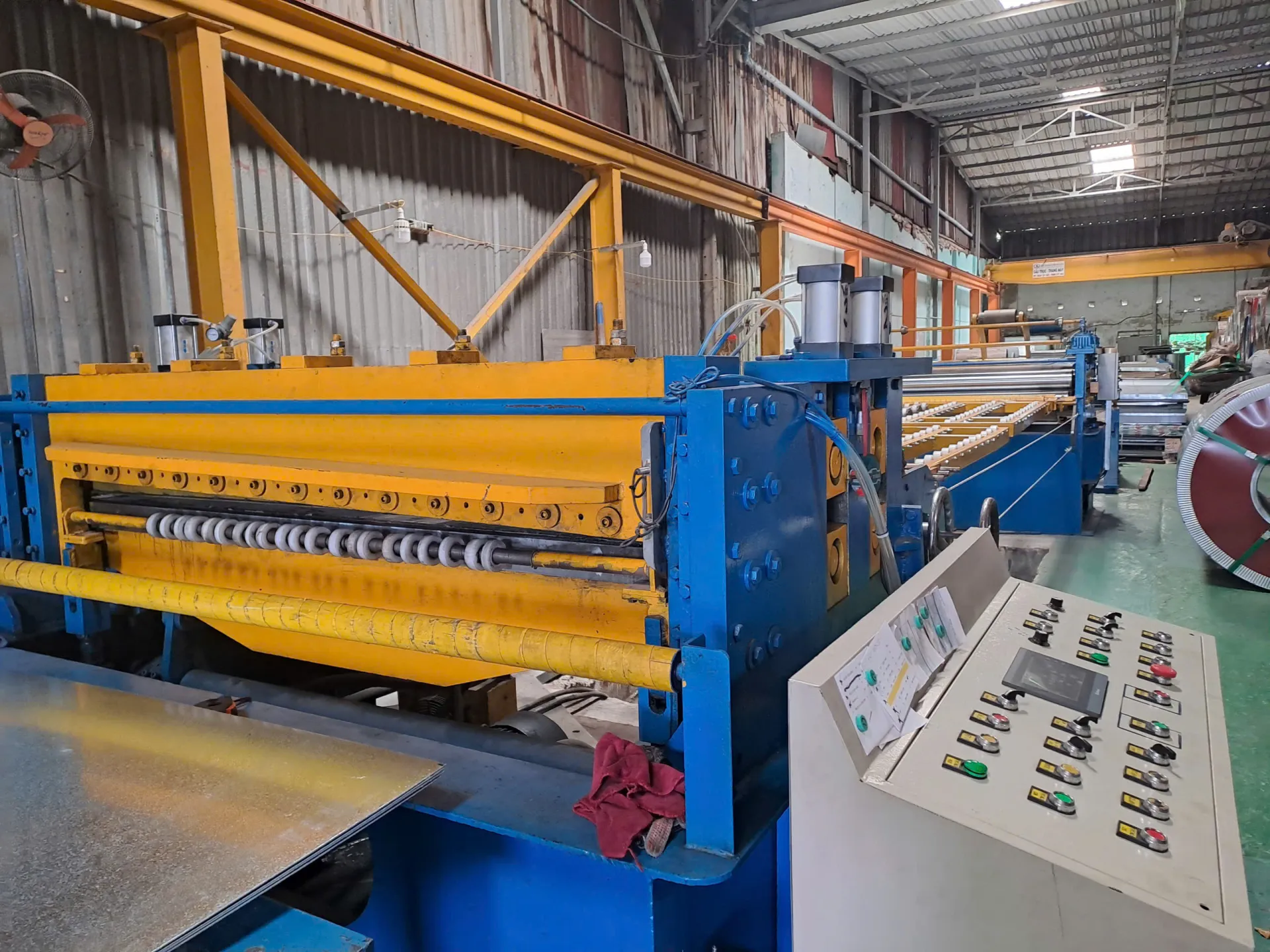
In practice, units possessing integrated slitting and fabrication machinery systems will have better stress control capabilities, thereby significantly reducing warping after cutting. This is especially important for orders requiring high precision or using large width steel sheet.
This is also why many mechanical engineering businesses prioritize choosing suppliers with direct fabrication capabilities at the warehouse, instead of processing through multiple intermediaries, to limit deviations and stabilize output quality.
6.3. Choosing a supplier with quality control
The choice of supplier not only affects cost but also directly determines the stability of the material during fabrication.
A reputable unit needs to ensure:
- Good control of flatness tolerance and steel sheet thickness tolerance
- Has an integrated fabrication system (slitting, cutting, bending)
- Clear billet source, full CO, CQ
In Ho Chi Minh City, Tôn Thép Phú Cường is one of the units capable of effectively controlling these factors thanks to modern machinery systems and direct fabrication processes at the warehouse. Limiting intermediate steps helps reduce the risk of uncontrolled stress release, thereby significantly improving material stability when put into production.
6.4. Optimize fabrication process
The fewer intermediate fabrication steps, the lower the likelihood of deformation. Therefore, businesses should prioritize solutions that simplify processes and effectively control each stage.
In many cases, direct steel sheet fabrication at the warehouse not only helps reduce costs but also significantly limits deviations caused by residual stress.
Tôn Thép Phú Cường – Leading Reputable Large Width Steel Sheet Distributor
In practice, controlling residual stress and material tolerance not only depends on the manufacturing plant but also heavily relies on the processing capabilities of the supplier. Choosing the right partner from the start will help businesses limit warping, reduce scrap, and optimize fabrication costs.
Tôn Thép Phú Cường – Accompanying Every Construction Project, providing material and fabrication solutions for mechanical engineering, construction, and industrial manufacturing businesses.

Key products
- Electro-galvanised steel sheet EG: high aesthetic surface, suitable for precision mechanical fabrication, metal furniture
- Electro-galvanised steel sheet GA: good stability, easy to fabricate, suitable for structures and technical parts
- Galvanised steel sheet: diverse coating thickness (Z100 – Z275), used for structures, outdoor construction projects
- Large width steel sheet (≥1500mm): reduces material loss, optimizes production
Fabrication services at the workshop
- Slitting – cutting to specification: tension control, limits warping after cutting
- Bending – stamping – forming: fabrication according to technical drawings, ensures accuracy
- Cutting to required dimensions: optimizes material, reduces loss
- Direct fabrication at the warehouse: reduces intermediaries, limits deformation due to transportation
Capabilities and advantages
- Modern, integrated machinery system
- Technical team knowledgeable in drawings and materials
- Genuine billet source, full CO, CQ
- Dedicated transport trucks, fast delivery – optimized costs
- Commitment to correct thickness, correct specifications, flat and clean cut surface
If you are experiencing steel sheet warping after cutting or need a stable material source for high-demand orders, choosing a unit with full fabrication and quality control capabilities will be a decisive factor for long-term effectiveness.
Contact Tôn Thép Phú Cường for suitable solution consultation:
Address: 2177C–2177D QL1A, P. Đông Hưng Thuận, Q.12, TP.HCM
Phone: 0933 919 899
Email: tonthepphucuong@gmail.com
Website: tonthepphucuong.com
See more related articles:
- How does width deviation after slitting affect bending, stamping, and construction project assembly?
- Where to Buy Reputable EG Steel Sheet in Ho Chi Minh City? Quotation & Experience in Choosing the Right Standard
- What is Electro-galvanised Steel? Why is it Widely Used in the Door, Electrostatic Painting, and Metal Furniture Industries?
- Mistake of only measuring steel sheet with calipers: Why do many contractors misjudge material quality?